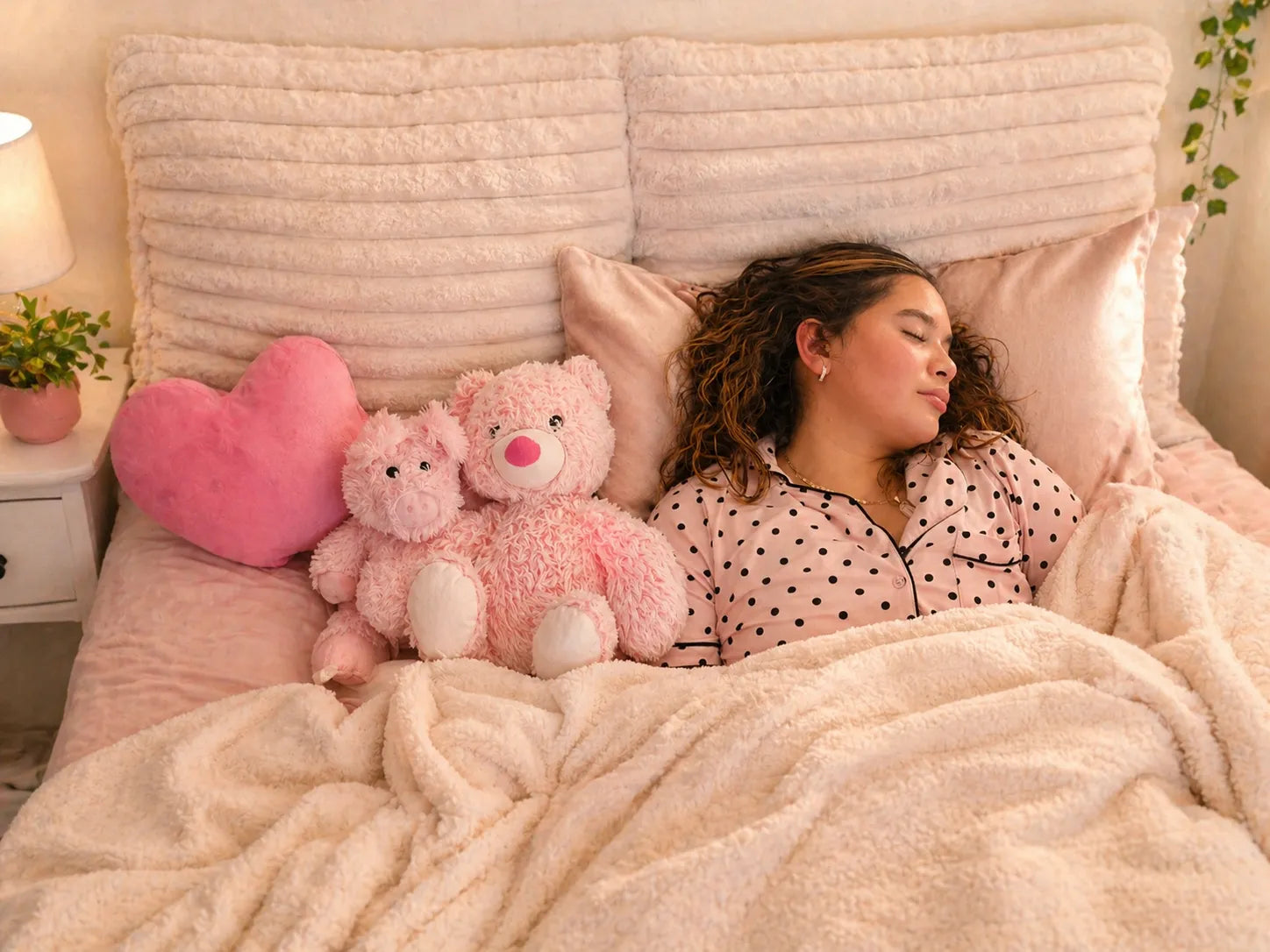
You press play to stop your own brain from talking. A familiar voice, the volume low, asleep before the first ad break. Then you surface at 3 AM to episode six of a true crime series, one earbud lost somewhere in the sheets, no idea when you actually drifted off. Falling asleep to podcasts and audiobooks is one of the most common sleep aids nobody calls a sleep aid. It works. It just needs three decisions most people never make on purpose.
Why a Voice Helps
Lying in the dark, your mind reaches for the only job left: rehearsing tomorrow, replaying today, auditing a conversation from 2019. Silence does not stop that. It clears the stage for it.
A voice gives your attention somewhere else to go. Not somewhere demanding, just somewhere occupied. Sleep researchers describe a technique called cognitive shuffling that works on the same principle: feed the mind a stream of low-stakes, disconnected input so it stops building problems to solve. A steady narrator does this for you automatically, with no technique to remember at midnight.
There is a second effect on top of it. At a low volume, a human voice softens the small sounds that pull you back toward waking: a car door, a radiator tick, a partner turning over. If your nights come apart because your thoughts will not close, start here: the best sounds for racing thoughts at night.
Where the Habit Backfires
Three things go wrong, and they go wrong in a predictable order.
- The episode is too good. Tension, cliffhangers, a plot twist at minute 40. Your body is ready to sleep and your brain refuses to leave the story.
- Nothing ever stops it. Autoplay rolls into the next episode, then the next. Sound keeps arriving through the lighter stages of your sleep, and you wake up mid-sentence, disoriented, at an hour with no business being awake.
- The hardware gives out before you do. The earbud digs into your ear canal the moment you roll onto your side. The phone slides off the mattress. Your partner asks you to turn it down. The content was never the problem.
Fix all three and this becomes the most dependable part of your evening. Fix none and you are trading a racing mind for a broken night.
Choose Boring on Purpose
The goal is not to enjoy the episode. The goal is to never find out how it ends. That inverts every instinct you have about picking something to listen to.
- Re-listens beat new releases. An audiobook you have already finished asks nothing of you. You can drop out at any sentence and lose nothing.
- Steady voice, flat delivery. Skip live audiences, laughter, three hosts talking over each other. One narrator at one pace.
- Watch the ad breaks. Ads are mixed louder than the show on purpose. A jump in volume at minute 12 undoes the previous 11.
- Long over short. A 90 minute episode carries you past sleep onset. A 20 minute one ends and hands you to whatever the algorithm picked next.
- Genres that reliably work: history explainers, nature documentaries, slow interviews, non-fiction you have read before, and podcasts made specifically for sleep. Sleep stories are the extreme version of this, written to be dull: do sleep stories work?
One useful test: if you would be annoyed to miss it, it is the wrong choice for 11 PM. Save it for the commute. The same test rules out the television, which fails it twice over: is it bad to sleep with the TV on?
Set the Timer First
This is the highest-leverage habit in the whole routine, and it takes four seconds. Set the timer before you press play, while you still care enough to do it.
Most people fall asleep within 15 to 30 minutes once they are settled. A 30 minute timer covers that with room to spare. Give yourself 60 if you tend to lie there longer. Anything past that is usually audio playing to an empty room while your battery drains and your phone sits in the bed with you.
Nearly every podcast and audiobook app has a sleep timer buried a tap or two deep. Find yours tonight. Better still, use a device with a timer built into the hardware, so the audio stops even when the app forgets. The Lullabar has 30, 60, and 120 minute settings on the device itself.
Slot this into the rest of your wind-down rather than treating it as the whole plan: how to build a bedtime routine that holds.
Then Fix the Delivery
You can pick the perfect episode and set a perfect timer, and still get woken at 1 AM by the thing you put in your ear. Every common option fails in a specific, physical way.
- Earbuds. Fine sitting up. Once you turn onto your side, the pillow presses the bud into your ear canal. Side sleepers usually last an hour before they wake up sore.
- Over-ear headphones. Comfortable and completely impractical in bed. Heat, bulk, and a cup that shifts every time you move.
- Phone on the mattress. Sound goes in every direction, which means straight to whoever is next to you, or in the next bed: how to sleep with a loud roommate. It also keeps your phone within arm's reach all night.
- Sleep headbands. Kinder than earbuds, but it is still a band around your head for eight hours, and the flat drivers migrate away from your ear as you move.
There is a different approach: take the speaker out of your ears entirely and put it under your pillow. Sound travels through the pillow fill to the ear resting on it. Nothing touches your ears, nothing straps to your head, and at sleep volume the person beside you hears nothing. Only your pillow carries it.
The full explanation of the mechanism is here: what pillow conduction audio actually is.
How Lullabar Handles It
The Lullabar was built for exactly this night: spoken audio, low volume, all the way to sleep, without waking anyone.
- 11mm thick, 47.5 g. It slides under your pillowcase and disappears. Roll onto it, roll off it, you will not think about it again.
- 40mm driver. Speech lives in the mid range, which is where a larger driver earns its keep. Voices stay clear and warm at volumes low enough to sleep through.
- Sleep timer on the device. 30, 60, or 120 minutes, set on the Lullabar itself. The audio ends on schedule whether or not your app cooperates.
- 10+ hours of battery. At normal volume, one charge covers the night with margin. Roughly 2 hours to refill over USB-C.
- Bluetooth 5.4. Pair once. It reconnects every night without you touching anything.
- 11 built-in sounds and micro-SD. Load audio onto a card and fall asleep with no phone in the bed at all.
- IPX4. Night sweats and a knocked-over glass of water are not an event.
If you share a bed, that combination is the one that matters. Your partner keeps their silence. You keep your audiobook. Nobody negotiates at midnight: how to sleep without disturbing your partner.
Common Questions
"Is it bad to fall asleep with a podcast on?"
Not by itself. Two conditions decide it. Keep the volume genuinely low, low enough that you strain slightly to follow it, and make sure it stops. Audio playing at volume through the whole night gives your brain something to keep processing during the lighter stages, and that is where a fragmented night comes from. A timer solves it.
"Will I remember any of it?"
Almost none of it, and that is the point. Your brain stops forming durable memories as you cross into sleep. This is why falling asleep to a language course or a book you are studying does not work. Use audio you are happy to lose.
"Podcast, music, or white noise?"
It depends on what is keeping you awake. If your thoughts will not close, a voice works best, because it occupies the same channel your thinking uses. Music suits mood and routine, as long as it is not catchy enough to replay at 3 AM: is it bad to fall asleep to music? If the problem is outside noise, traffic, thin walls, or a snorer, steady sound masks better than speech does, and which frequency you pick decides whether it works. Full breakdown here: the complete guide to sleep sounds.
"Will my partner hear my podcast?"
At sleep volume, no. The sound travels through the pillow fill to the ear resting on it, so they would have to put their head on your pillow to make out what is playing. Turn it up loud and it becomes audible to them, the same as any speaker.
"My audiobook app has no sleep timer."
Then put the timer in the hardware. The Lullabar's 30, 60, and 120 minute settings run on the device, so it stops on its own no matter what the app is doing. Your phone can keep playing to nobody while you sleep through it.
The Bottom Line
Falling asleep to a voice is a good instinct. Most people just leave it to chance: whatever autoplayed, whatever volume it landed on, whatever was in their ears from the day.
Make three decisions instead. Pick something you would not mind missing. Set a 30 minute timer before you press play. And stop putting hardware in your ears that your pillow is going to press into you at 1 AM.
Try the Lullabar for 30 nights and hear what the last one feels like.